Food Dehydrators: What Buyers Really Need to Know Before They Choose One
Food Dehydrators are one of those kitchen appliances that look straightforward until you have to choose one for actual use. On paper, they all do the same thing: move warm air through sliced food and remove moisture. In practice, the details matter a lot. Tray spacing, temperature control, cabinet material, airflow behavior, and even whether you can see the product without opening the door all affect the final result.
For home kitchens, small food businesses, and OEM/ODM appliance brands, the decision is usually less about “does it dehydrate?” and more about consistency, batch size, and how much control the operator really has. That is where the difference between a decent countertop unit and a frustrating one becomes obvious.
Why dehydration equipment is still relevant
Drying food is one of the oldest preservation methods, but the modern countertop electric dehydrator has made it more precise and a lot more convenient. Instead of relying on sun drying or improvised low-heat ovens, buyers now expect a controlled chamber, stacked trays, and a predictable drying cycle.
That matters for three reasons.
First, texture. Fruit slices, vegetable chips, herbs, and jerky-style snacks all dry differently. If airflow is uneven or the temperature is hard to manage, you can end up with brittle edges and damp centers.
Second, shelf stability. Removing moisture helps slow spoilage, which is why dehydration remains useful for snack production and food preservation.
Third, product consistency. For anyone producing in small batches, consistency is not cosmetic. It affects customer experience, rework, and waste.
A quick look at the type of machine shown here
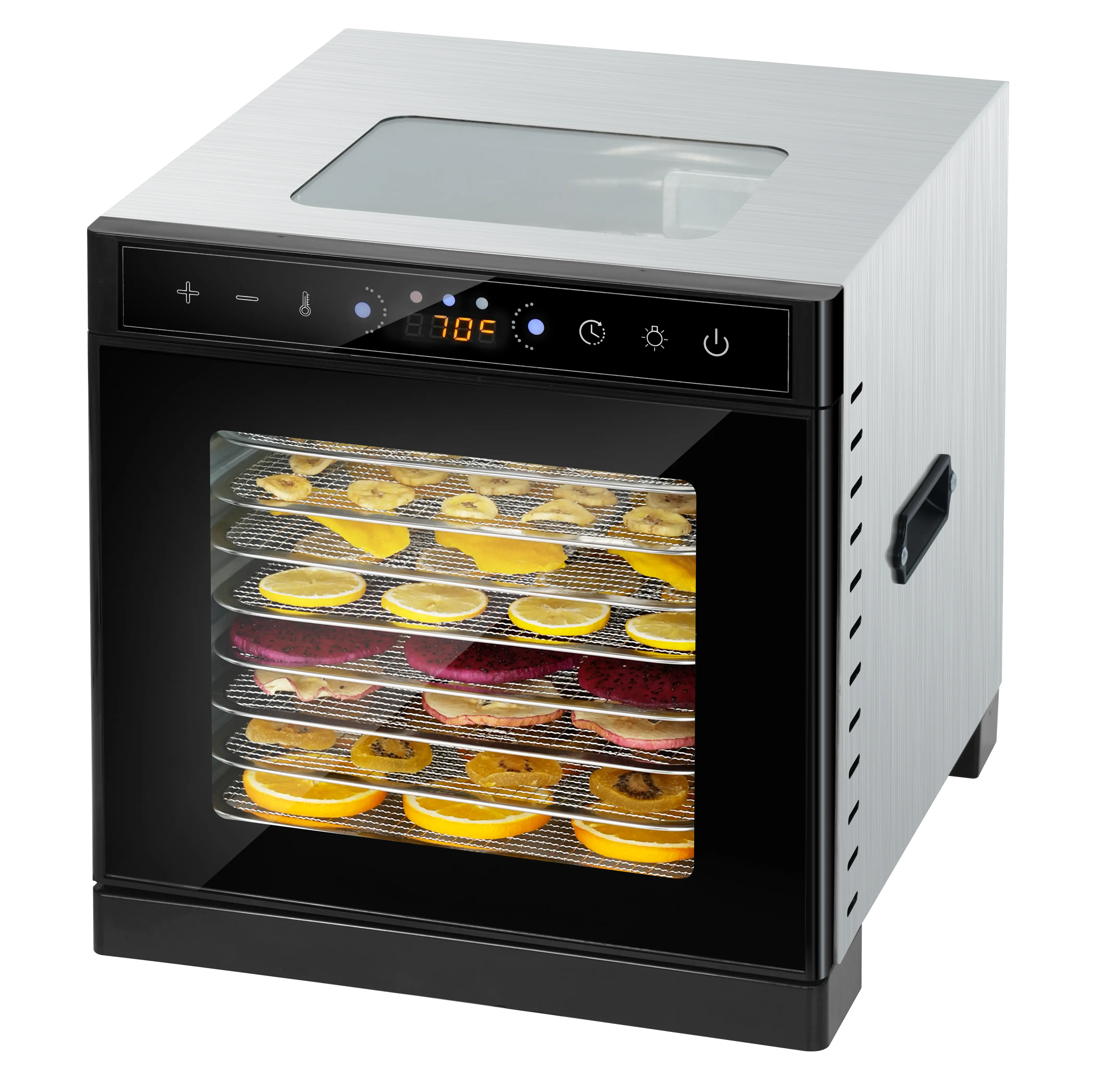
The unit described here is a countertop electric food dehydrator with a cabinet-style body. The outer housing appears to be brushed stainless steel, with a black front frame and a transparent viewing window in the front door. There is also a top viewing window, which is useful from an operator’s standpoint because it lets you inspect the load without opening the chamber and losing heat.
Inside, the machine uses multiple removable wire-mesh trays. At least five stacked trays are visible in the chamber, each carrying sliced fruit or vegetable pieces. That tray style is practical because it allows air to circulate around the product instead of trapping moisture under a solid surface.
The front digital control panel includes touch-style icons, plus/minus adjustment, a temperature display, timer icon, and light/power symbols. The display appears to show 70°C. That tells you the unit is designed for controlled low- to moderate-temperature drying rather than simple warm-air holding.
What the construction tells a buyer
The visible materials say a lot about how the machine was built, even without seeing the interior heating assembly.
A stainless-steel outer shell is common in appliances that need a cleaner appearance and easier wiping. For commercial-style use, that can be more practical than a fully plastic cabinet, especially around food prep areas. The black front frame and door help define the sealed viewing area and usually make the control interface easier to read.
The wire-mesh trays are another useful detail. Mesh trays are typically favored because they reduce contact area and let air pass through the food load. That is important when drying thinner slices of apple, mango, zucchini, mushrooms, or herbs. Solid trays tend to hold moisture longer unless the product is very carefully arranged.
A small caution here: the visible design suggests a product intended for countertop use, but countertop appliances can vary widely in actual usable capacity. A chamber may look generous from the outside and still perform best with modest tray loading. Buyers should not assume physical size equals throughput.
How Food Dehydrators are usually evaluated by buyers
There are a few practical questions that matter more than brochure language.
1. Is temperature control precise enough for the product?
Different foods need different treatment. Fruit often benefits from steady drying without scorching. Herbs need gentle handling to preserve aroma. Jerky-style products require a more controlled process, and buyers should be careful not to confuse casual snack drying with food-safety-critical meat processing. If the machine allows clear temperature adjustment, that is a good sign, but the buyer still needs to match the machine to the intended product.
2. Does the airflow support even drying?
This is where many low-cost units disappoint. A dehydrator can have a nice control panel and still produce uneven trays if airflow is weak or poorly directed. The result is one tray that dries too quickly and another that stays soft longer than expected. For multi-tray use, this is one of the first things worth testing.
3. Are the trays easy to remove and clean?
Food residue is part of the process. Sticky fruit can cling to mesh, and herbs shed fine fragments. If trays are hard to remove or difficult to wash, the machine becomes tedious to use. In a small business environment, that means more downtime between batches.
4. Can the operator monitor the load without disruption?
The viewing windows are not a luxury. They help reduce unnecessary door opening, which can interrupt the drying cycle. For a small operator checking batch progress, that saves time and helps preserve temperature stability.
Common applications that justify the purchase
A machine like this is not just for hobby use, though it certainly works for that.
Home users often buy Food Dehydrators for dried fruit snacks, apple rings, banana chips, herb storage, and batch preparation for pantry use. The appeal is simple: less waste and more control over ingredients.
Small food businesses may use them for test batches, seasonal fruit processing, or specialty snack development. That is especially true when the business wants to trial products without committing to large industrial equipment.
OEM and ODM buyers may look at this cabinet style as a platform for private-label kitchen appliance lines. In that context, exterior finish, panel layout, tray count, and visual design can matter as much as basic function. A buyer in that position usually wants a machine that looks modern on a countertop and is easy to explain to end customers.
Practical selection criteria that are easy to overlook
If you are sourcing this kind of appliance, the most useful checklist is not glamorous.
Look at the chamber layout first. Multi-tray machines are attractive because they increase batch capacity, but only if the top and bottom trays dry at similar rates.
Pay attention to door sealing and visibility. If the door leaks heat or fogs up immediately, inspection becomes harder and energy use may suffer.
Check whether the controls are intuitive enough for non-technical users. A temperature display and timer are expected, but the interface should be readable at a glance.
Confirm what product family the machine is meant for. Fruit and vegetables are straightforward. Herbs are gentler. Meat products require more care and should not be treated casually just because the appliance can run warm air through a chamber.
And one more buyer-facing warning: do not assume a visually polished countertop unit is suitable for continuous heavy-duty operation just because it has a stainless-steel body. The exterior finish says little about the internal fan life, heater design, or duty cycle.
Typical mistakes buyers make with dehydrator purchases
One common mistake is overestimating capacity. Buyers see multiple trays and assume full loading is fine for every product. In reality, spacing and slice thickness matter just as much as tray count.
Another mistake is ignoring workflow. If the trays are awkward to load or the display is confusing, staff will use the machine less efficiently than expected.
A third mistake is choosing purely on appearance. A brushed metal cabinet and glass windows look professional, but functionality comes first: consistent airflow, controllable temperature, and cleanable surfaces.
Finally, some buyers forget that dehydration is a process, not just an appliance. Slice size, moisture content, arrangement on the tray, and desired end texture all affect results.
What to ask a supplier before placing an order
For sourcing teams, a short list of direct questions usually saves time.
Ask how many trays are supported and whether the tray spacing can handle thicker slices.
Ask what temperature control range is available and how the display is calibrated.
Ask whether the trays, window panels, and control interface can be customized for OEM or ODM programs.
Ask what food categories the machine is intended for, especially if you plan to market it for broader kitchen use.
If the supplier cannot explain the drying workflow clearly, that is worth noting. Good appliance suppliers should be able to talk about load arrangement, not just exterior design.
FAQ
Can Food Dehydrators be used for fruit and vegetables?
Yes. That is one of the most common applications, and the visible tray setup in this type of machine is well suited to sliced fruit and vegetable pieces.
Why is a viewing window useful?
It lets the operator check progress without opening the chamber and disturbing the drying cycle.
Is a digital display enough to judge performance?
No. It helps with control, but real performance depends on airflow, chamber design, tray arrangement, and how evenly the product dries across the load.
Are all dehydrators suitable for every food type?
Not exactly. Fruit, vegetables, herbs, and meat products behave differently, so the intended application matters.
A sensible next step for buyers
If you are comparing Food Dehydrators for a home product line, a small commercial kitchen, or a private-label appliance program, start with the drying chamber itself rather than the sales sheet. Look closely at tray design, visibility, control simplicity, and how the machine would fit into real daily use.
A well-designed countertop dehydrator should be easy to load, easy to monitor, and predictable from batch to batch. That sounds simple, but in this category, those are the details that separate a useful machine from one that ends up parked in storage after a few weeks.