Why buying slicing machines is less simple than it looks
Slicing Machines seem straightforward until a kitchen, commissary, or small processing line has to use one every day. Then the real questions show up: Will it cut consistently? Is it easy to clean? Can it sit on a crowded bench without creeping around during service? For buyers, the decision is rarely about a single feature. It is about how the machine fits the work, the staff, the cleaning routine, and the way the business actually runs.
That is especially true with compact countertop kitchen slicers and cutting machines. The visible design may suggest a simple appliance, but the purchase decision often sits at the intersection of food prep speed, operator safety, stainless-steel durability, and sourcing reliability. If you are comparing options for a brand, a distributor line, or a commercial kitchen, the goal is not to buy the most impressive-looking unit. It is to buy the one that will keep producing the same result after a long week and a lot of washing down.
What the visible product design tells a buyer
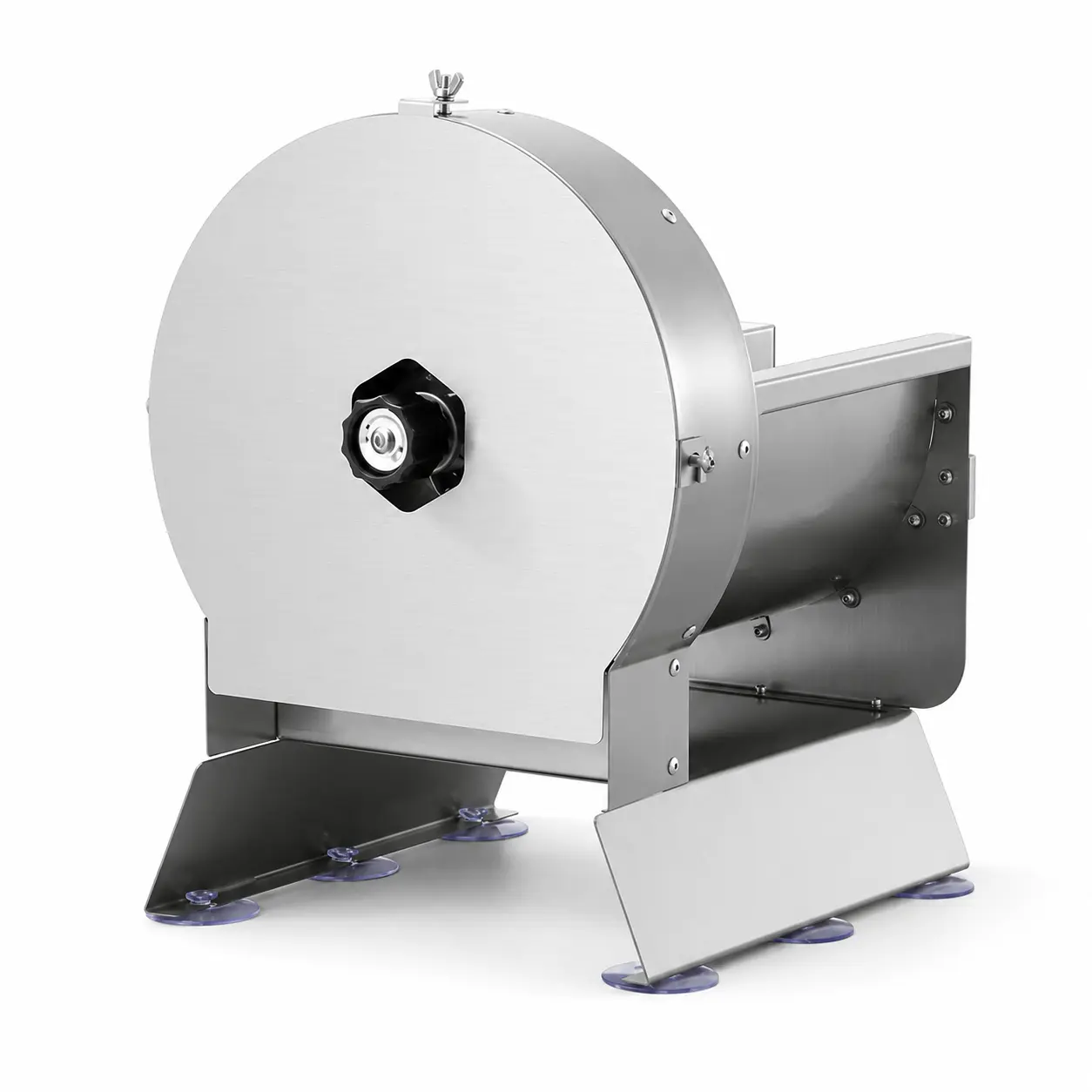
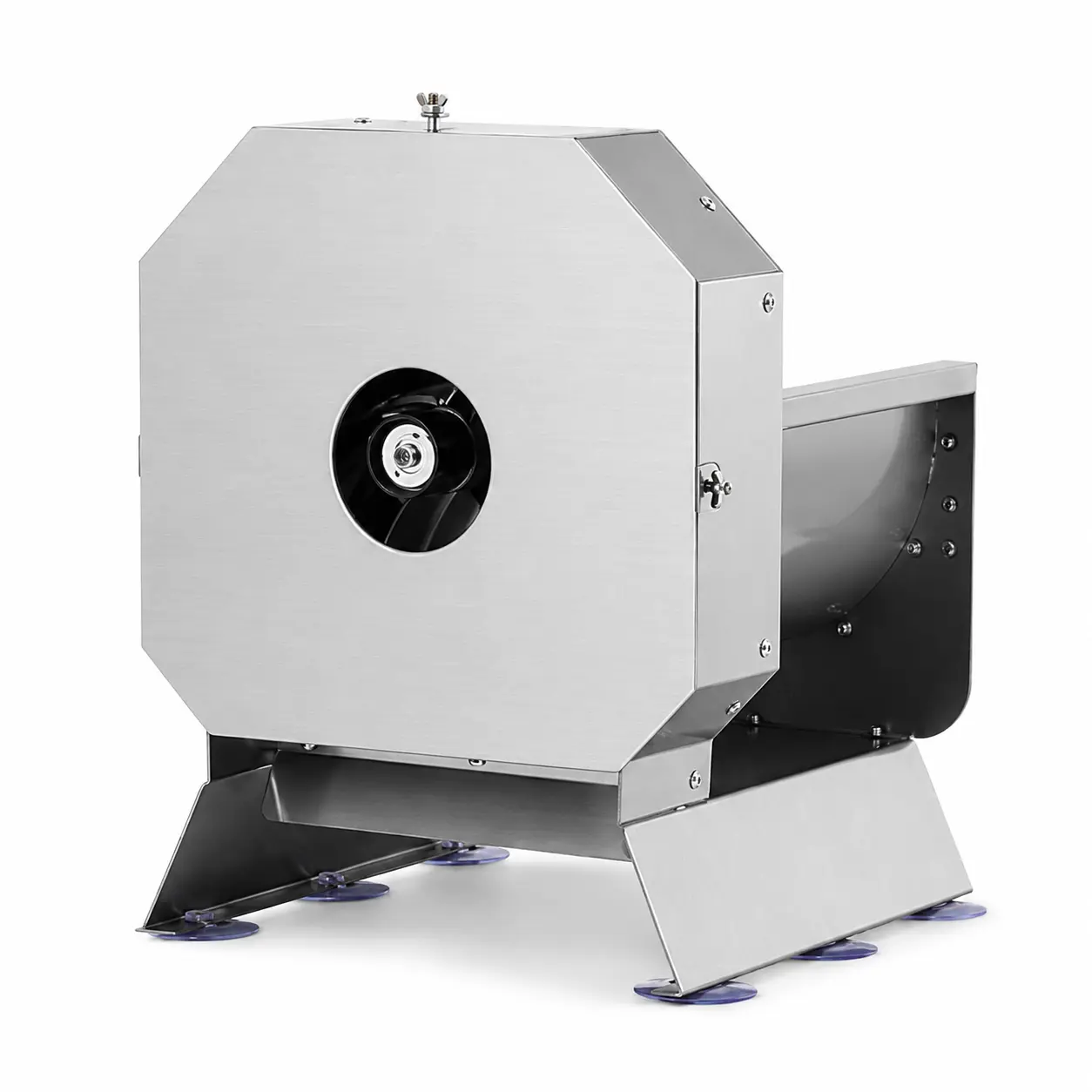
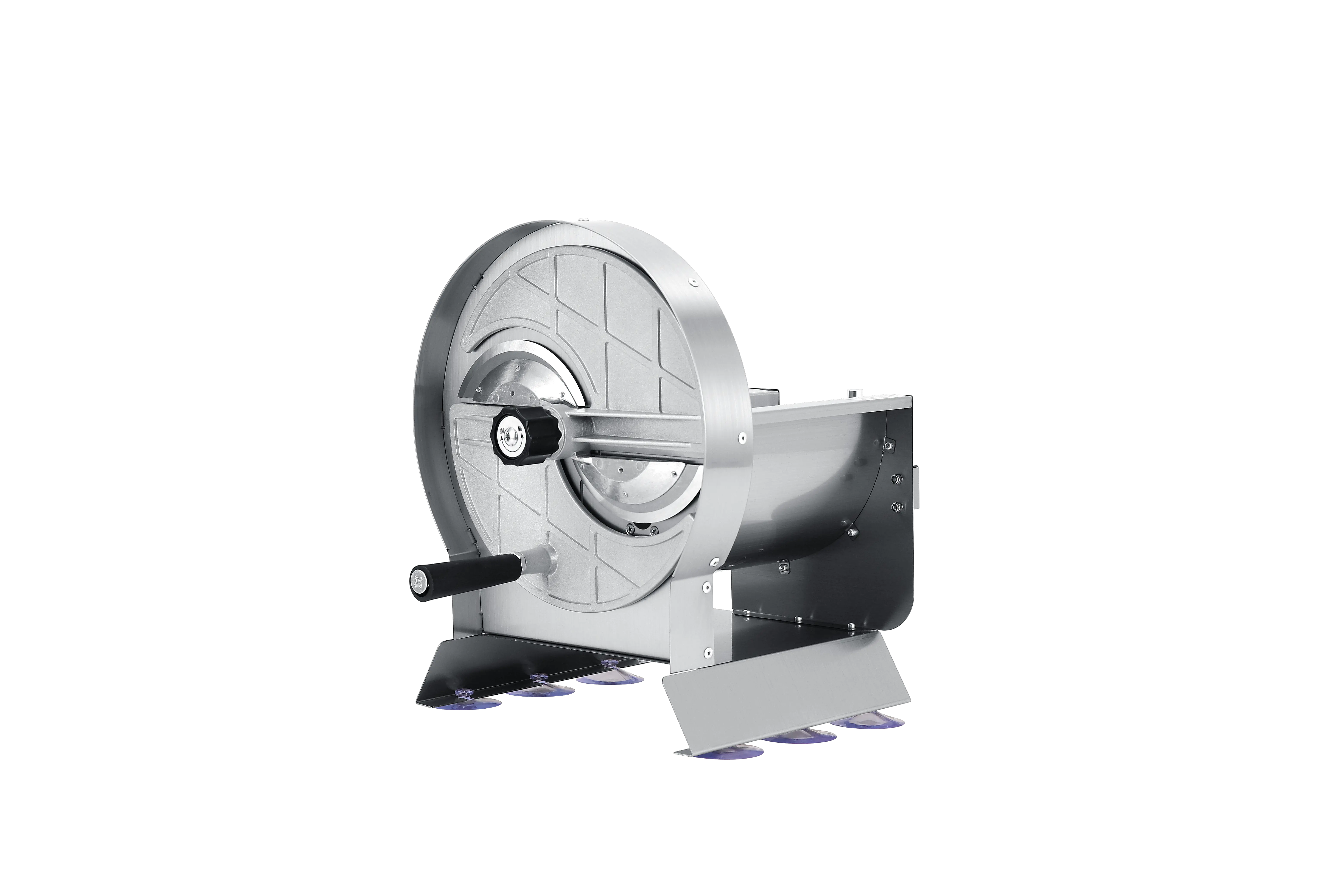
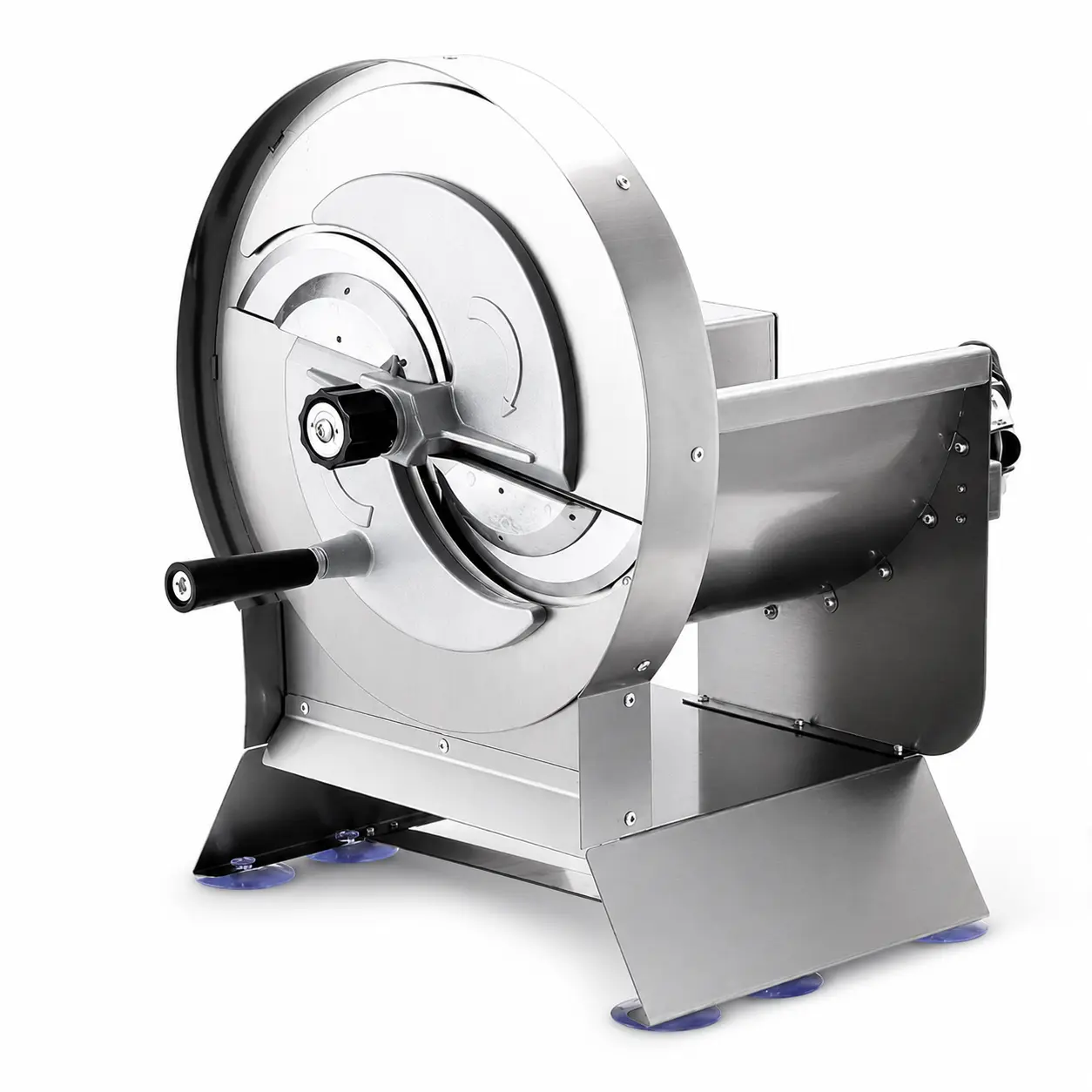
The product described here is a bench-top, stainless-steel appliance with a boxy horizontal body, a large circular front housing, and a compact footprint. That matters more than it sounds. In equipment sourcing, the physical layout often tells you where the manufacturer has placed priority: stability on the counter, accessible handling, and a structure that can be fabricated and assembled efficiently.
The brushed or satin stainless-steel body suggests a focus on food-contact environments and easier wipe-down cleaning. The round front cover with a central hand-tightened knob points to a design that likely needs routine access for cleaning or internal service. The suction-cup feet at the base are another small but practical detail. On a wet or vibrating work surface, that kind of support can make the difference between a machine that feels solid and one that slowly walks across the counter.
Of course, the exact internal cutting mechanism is not visible, so buyers should not assume too much from the exterior alone. Whether the machine is aimed at fruits, vegetables, meat, or another food category depends on the hidden blade set, drive system, and safety design. That is one reason procurement teams should ask for application-specific documentation instead of reading the shell like a full spec sheet.
What buyers usually need from a countertop slicer
Most sourcing teams are not looking for novelty. They are looking for repeatability. A good kitchen slicer should help staff process ingredients at a steady pace with minimal training, minimal mess, and minimal downtime. In smaller production settings, that can mean reducing hand labor. In retail or hospitality, it can mean keeping prep work from becoming the bottleneck.
When evaluating Slicing Machines, three questions usually matter first:
Does it produce a uniform result that suits the menu or product line?
Can staff clean and reassemble it without turning every shift change into a maintenance event?
Can the supplier support steady replenishment, spare parts, and sample or custom orders when the business grows?
That last point is easy to overlook. A machine may look good in a product photo, but if the supplier cannot support sampling or custom bulk delivery, the purchase can become a one-off rather than a scalable sourcing program.
Quick takeaways for sourcing and engineering teams
The product and factory information provided here gives a few useful commercial signals. The company states 7-day sample production, one-month customized bulk delivery, 24–48 hour shipping for some stock items, and peak daily shipment up to 2000 units. It also lists 8 production lines and certifications including ISO9001, CE, FCC, and UL.
For buyers, those details suggest a supplier that is set up for both sample development and higher-volume fulfillment. That does not replace your own qualification process, but it does indicate that the factory is used to managing multiple order types rather than handling only small trial runs.
That matters if you are sourcing appliances for a private label range, regional distribution, or a hospitality channel that needs a dependable restock path. A sourcing manager should still verify product scope, packaging, and compliance for the target market, but the operating profile here is more promising than a workshop-level supplier with no visible production depth.
How the stainless-steel construction helps in real use
Stainless steel is not just about appearance. In commercial kitchens, it is chosen because it resists corrosion better than many painted or mixed-material alternatives, and because it generally tolerates the kind of cleaning expected around food equipment. The satin finish also tends to hide fingerprints and light scuffing better than high-gloss surfaces, which is a small thing until the machine has been in a live kitchen for two weeks.
The downside is that stainless equipment can still show wear if the design includes too many seams, sharp folds, or hard-to-reach corners. Buyers should look closely at panel joins, fasteners, and access points. A machine can be all stainless on paper and still be awkward to clean if the geometry traps residue. That is particularly important for any food prep machine that sees repeated disassembly.
The circular front housing and lower access area suggest a design built around serviceability as much as processing. That is a good sign, but it should be confirmed in practice. Ask how the user reaches the working parts, what tools are needed, and how long routine cleaning actually takes. A five-minute task in a brochure can become a 20-minute frustration on a busy prep line.
Selection criteria that matter more than marketing language
Fit for the actual ingredient mix
Buyers often make the mistake of asking whether a slicer is “good for food” in general. That is too broad. Ask what kinds of ingredients it is intended to handle and whether the output matches your production need. A machine designed for one application may not translate cleanly to another, even if the body looks similar.
Footprint and counter stability
Compact countertop kitchen slicers have to earn their space. Measure not only the base area but also the clearance needed for loading, cleaning, and removing the output. Suction feet help, but they do not solve an overcrowded workstation.
Cleaning and maintenance access
Any machine that touches food should be easy to inspect and clean. Removable covers, accessible edges, and simple fastening systems usually reduce daily friction. If the unit requires awkward disassembly, staff will eventually take shortcuts. That is a food safety issue as much as a labor issue.
Supplier responsiveness
The stated sample production and delivery schedule suggests the manufacturer is structured for OEM/ODM work. For buyers, that can be useful when testing a branded line or adapting packaging. Just remember that responsiveness on paper should be verified with samples, drawings, and communication quality before you commit to a larger order.
Common mistakes when buying slicing equipment
The first mistake is buying only by appearance. A neat stainless shell does not tell you much about cutting performance, motor durability, or cleanup burden.
The second mistake is ignoring the actual service environment. A machine that works fine in a light-use demo kitchen may struggle in a high-turnover prep room where staff are under pressure and every surface gets wet.
The third mistake is skipping supplier qualification because the product category seems simple. With Slicing Machines, the machine may be only part of the purchase. Packaging, spare parts, support for custom branding, and shipping readiness can matter just as much as the appliance itself.
One more practical caution: if the seller cannot clearly explain the machine’s intended food use, do not guess. Ask for application details. It is better to pause a purchase than to discover later that the unit is poorly matched to the ingredient profile.
Questions to ask before placing an order
What ingredient types is the machine designed for?
How is the cutting area accessed for cleaning and inspection?
What parts are considered consumable or service items?
Can the supplier provide samples quickly, and what is the path from sample to customized bulk delivery?
Which certifications are available for the target market, and which should be verified for your region?
What packaging, labeling, and branding options are offered for OEM or ODM programs?
Those are basic questions, but they separate a useful sourcing discussion from a glossy catalog conversation.
FAQ: what buyers usually ask
Are these machines only for commercial kitchens?
Not necessarily. The compact countertop format can suit home-kitchen use, small food processing setups, and commercial environments. The right fit depends on workload and ingredient type.
Does the visible design tell me the exact performance?
No. The exterior gives clues about construction and usability, but not enough to confirm slicing capacity, motor type, blade design, or throughput.
Why do production capacity details matter?
Because buyers need more than one good sample. If a supplier can move from 7-day samples to customized bulk delivery in about a month, and has multiple production lines, that helps reduce rollout risk.
Should I prioritize certifications first?
Certifications matter, but they should be matched to the market and the product category. They are part of the screen, not the entire decision.
A practical next step for buyers
If you are sourcing countertop slicing equipment, start by defining the ingredient use case, the expected daily load, and the cleaning routine your staff can realistically maintain. Then ask the supplier for a sample, confirm the construction details, and review how the machine is configured for your market. The supplier information provided here points to a factory capable of sample production, customized bulk supply, and higher-volume shipment, which makes it worth a closer look for brands and distributors.
Before you move to order quantities, make the supplier prove the practical details: application fit, service access, market compliance, and packaging. That is the difference between buying a machine and buying a production tool that will still make sense after the first busy season.