Why a Food Dehydrator with Button Control Still Matters
A Food Dehydrator with Button Control looks simple on the surface, but for buyers in food production, private-label appliance sourcing, or small commercial kitchens, it solves a very practical problem: turning perishable ingredients into stable, shelf-ready product without relying on guesswork. That matters whether the end goal is dried fruit snacks, herb blends, vegetable chips, or test batches for a new product line.
The appeal is not just the drying itself. It is the ability to repeat a drying routine, watch the load through a front window, and make small adjustments without opening the cabinet every few minutes. That sounds minor until you are trying to keep texture consistent across different fruit thicknesses or humidity levels. In drying work, consistency is the business.
This style of countertop unit is especially relevant to engineers and sourcing teams because it sits in a useful middle ground: compact enough for a kitchen worktop, but more controlled than ad hoc air-drying or a makeshift oven setup. The stainless-steel exterior, stacked mesh trays, and front-facing controls suggest a machine designed for routine use, not just the occasional batch.
What Buyers Can Tell at a Glance
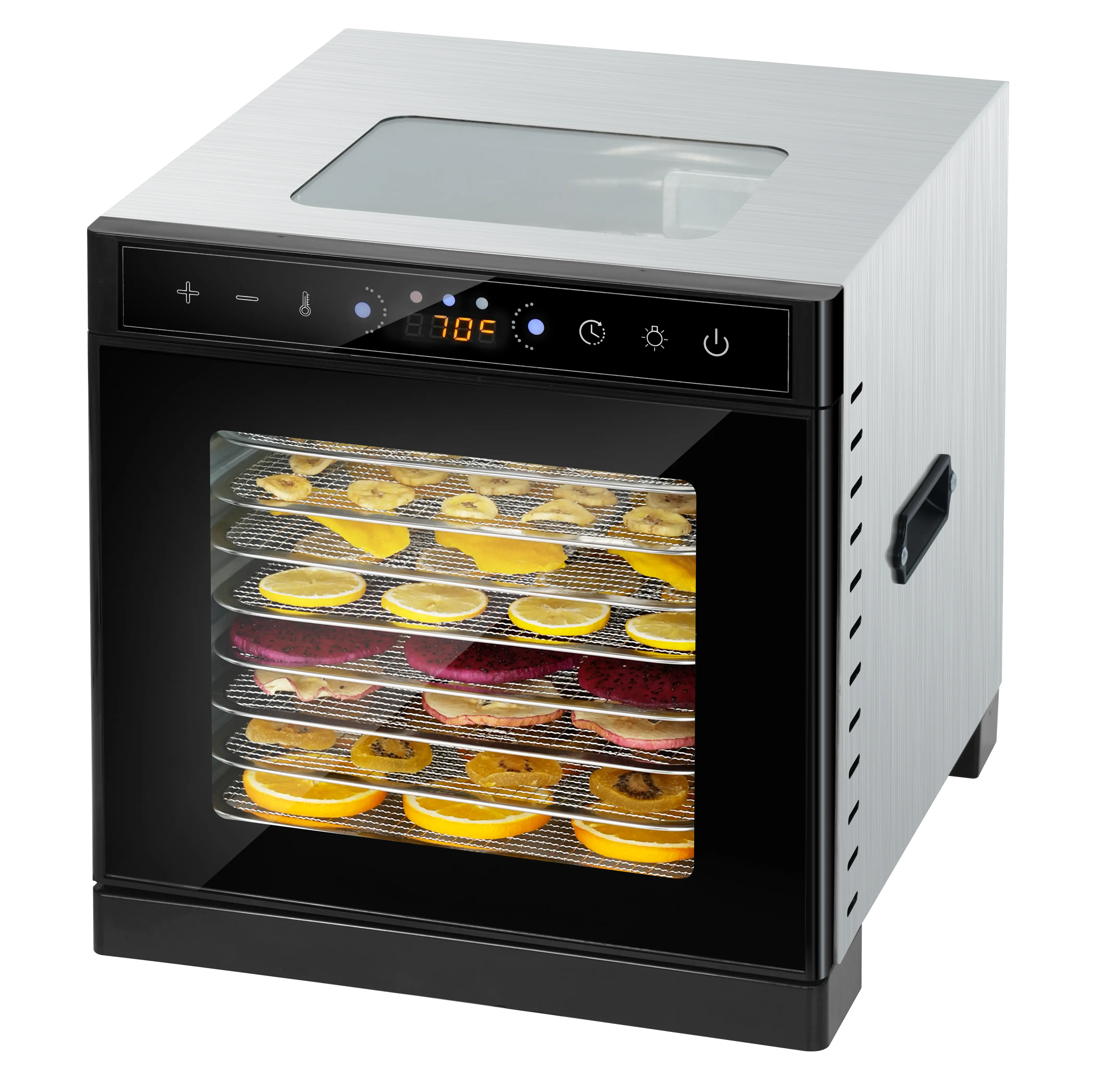
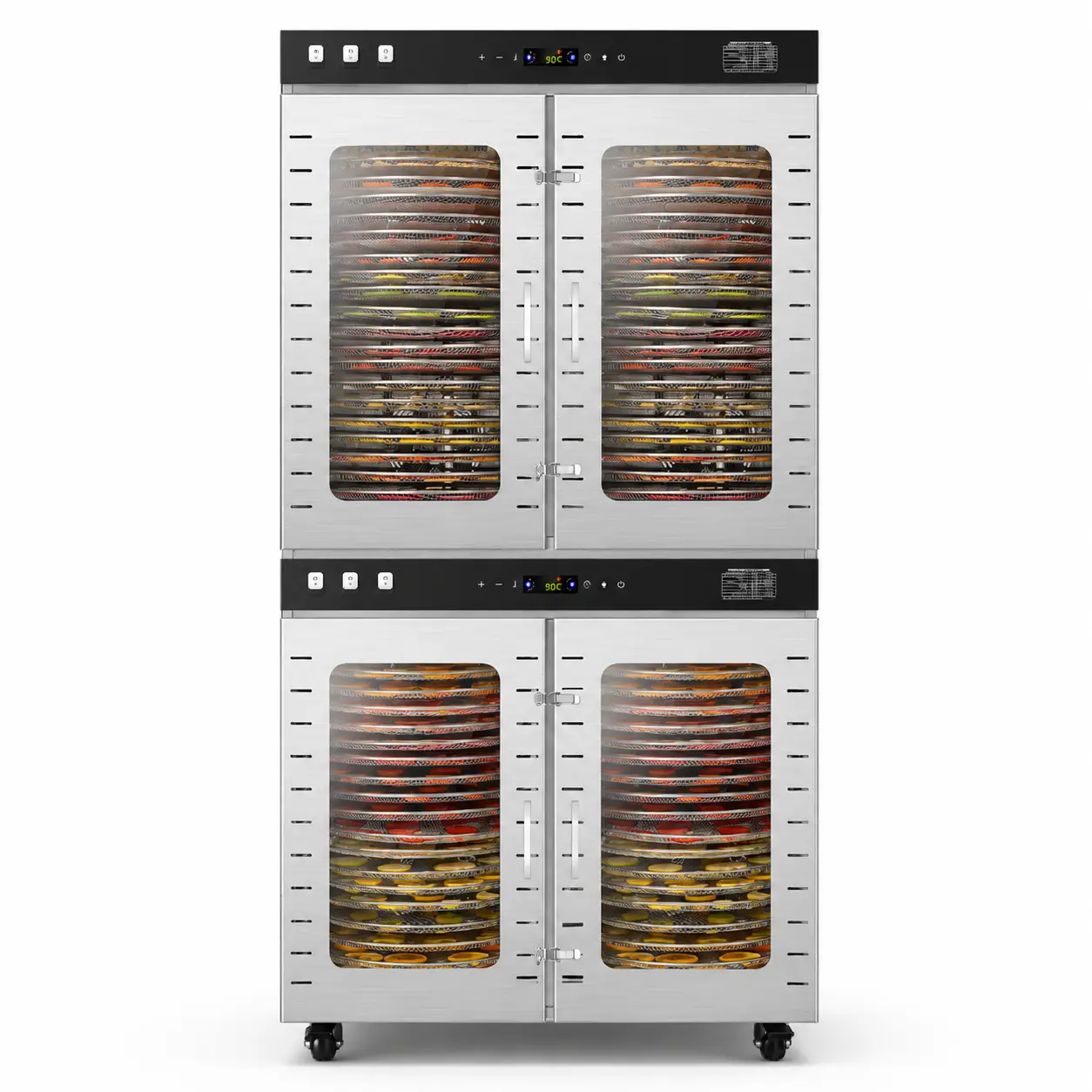
Based on the visible product details, this dehydrator appears to be a rectangular countertop appliance with brushed stainless-steel outer panels, a glossy black control fascia, and a transparent viewing window in the front door. Inside, multiple perforated trays are stacked on rails, which is the standard layout for batch drying sliced food.
The front panel shows a digital readout around 30°C, along with round push buttons and indicator lights. That does not tell us the full temperature range or whether the machine includes presets, but it does indicate a control style that is more deliberate than a basic one-switch appliance. For many buyers, that is enough to matter. Button control can be easier for operators to learn, simpler to document in a production setting, and less fiddly than touch interfaces in a damp or busy work area.
A few details stand out as practical buying signals:
Quick-reference strengths
The unit appears compact enough for countertop use.
The front window supports visual monitoring without opening the door.
The stackable trays suggest a multi-layer batch format.
The metal exterior should be easier to wipe down than a fully plastic housing.
The display and push buttons suggest basic process control rather than a purely mechanical timer-only approach.
What a Button-Control Dehydrator Is Good For
For home users, this kind of appliance is often used for drying sliced fruit, vegetables, and herbs into snack foods or pantry ingredients. For sourcing managers and product teams, the more interesting use case is smaller-scale processing: pilot batches, recipe development, seasonal preservation, and packaging trials.
That is where a Food Dehydrator with Button Control earns its keep. Drying is sensitive to thickness, load density, and ambient conditions. A machine that lets the operator set and verify conditions in a straightforward way is useful when you are trying to learn whether a product will hold its texture, color, or flavor after dehydration. A test batch that looks good in one tray and leathery in another is not a success; it is a process issue.
The visible temperature display around 30°C also hints at lower-temperature operation, which is often preferred for preserving delicate fruit and herbs. Still, buyers should avoid reading too much into a single display image. The actual temperature range, airflow behavior, and timer logic are not verified here, so those points need to be confirmed on a datasheet or sample unit.
Selection Criteria That Actually Affect Results
When choosing a dehydrator in this category, buyers usually focus on specifications, but the build details matter just as much. A machine can look professional and still be awkward to use if the trays flex too much, the door leaks heat, or the airflow is uneven.
1. Tray layout and usable space
The number of trays visible is only part of the story. What matters is the spacing between trays, the usable tray area, and whether the load dries evenly from top to bottom. If you plan to dry thin fruit slices, herbs, or vegetable chips, tray geometry becomes a real process variable.
2. Control type
Button controls are often underrated. In a production or product-development environment, they can be easier to operate consistently than a touch panel, especially if the user is wearing gloves or working around moisture. The tradeoff is that button-based interfaces may offer fewer advanced features, so buyers should verify what settings are actually available.
3. Viewing and access
The transparent front window is not a luxury. It reduces the need to open the door and release heat during a run. That can help keep the batch more stable, though it does not replace checking product condition by hand when necessary.
4. Housing and cleanability
A stainless-steel outer shell is a sensible choice for a machine that may be used repeatedly and wiped down often. That said, buyers should ask about the tray material, internal surfaces, and how easy the unit is to clean around corners, rails, and the door seal. Those are the places where real maintenance time gets spent.
Common Mistakes Buyers Make
One common mistake is assuming all dehydrators behave similarly because they all have trays and a heater. They do not. Airflow pattern, tray spacing, and door design can change drying behavior enough to affect texture and batch time.
Another mistake is buying solely on exterior appearance. The stainless-steel finish and digital display create a solid first impression, but the important questions are still functional: Does the temperature hold steadily? Is the airflow even? Can the operator monitor the load without interrupting the cycle? Those answers matter more than a polished fascia.
A third, more practical issue is overloading. Even a well-designed dehydrator will underperform if trays are packed too tightly or if slices are cut unevenly. Buyers evaluating a machine for private-label or small-batch work should think about process discipline as much as equipment.
Where This Type of Appliance Fits in an ODM/OEM Conversation
Because the provided product notes suggest a possible ODM/OEM appliance line, it is worth stating the obvious: buyers in that channel should separate appearance from specification. A machine like this may be a good base platform for branded kitchen appliances, but the sourcing decision should still hinge on verifiable technical data.
Ask for the documented controls, electrical specifications, material callouts, tray count, internal dimensions, and any testing that is actually available. If the supplier cannot confirm a detail, treat it as unknown. That is normal in early discussions and much better than building a product plan around assumptions.
For private-label brands, the visible design cues here are useful because they signal a marketable, modern countertop product. But brand teams will still need to confirm whether the platform supports their target price point, safety requirements, and packaging strategy.
Practical Buyer Advice Before You Order
If you are comparing a Food Dehydrator with Button Control against other countertop drying appliances, the safest approach is to test for the few things that determine real-world satisfaction:
Check whether the controls are intuitive without reading a manual three times.
Confirm that the viewing window stays clear enough to be useful during a run.
Review the tray handling method, because easy loading matters more than buyers expect.
Ask for confirmation of temperature range and airflow design rather than assuming the display tells the full story.
If the machine is intended for product development, make sure you can reproduce results across multiple batches, not just one successful sample.
A small caution here: buyers sometimes overestimate the value of extra features and underestimate cleaning and repeatability. In drying equipment, those two basics usually decide whether a machine becomes part of the daily workflow or sits on a shelf after the first few trials.
FAQ
Is button control better than touch control?
Not always, but button control is often easier to use in a kitchen or light production environment. It can be more tactile and less sensitive to moisture or hurried operation.
Can this type of dehydrator handle more than fruit?
Yes, the same general format is commonly used for vegetables, herbs, and similar foods. Actual suitability depends on temperature control, airflow, and tray design.
Is the stainless-steel exterior enough to judge durability?
It is a positive sign, but not a full durability guarantee. Internal construction, door sealing, tray strength, and control quality are equally important.
Does the viewing window improve results?
It can help operators monitor progress without opening the door, which reduces unnecessary heat loss. It is useful, though not a substitute for proper process control.
A Clear Next Step for Buyers
If you are evaluating this category for home use, small-batch food processing, or a private-label appliance program, the next step is not to chase marketing language. It is to request the missing technical details and compare them against your actual use case. Start with the controls, the tray system, the real temperature capability, and the cleanability of the unit.
A Food Dehydrator with Button Control can be a sensible, practical machine when the design matches the workload. The visible build suggests a compact, monitoring-friendly appliance with a straightforward interface. What remains is the part that matters most to engineers and buyers: proving that the product performs consistently when the trays are full and the clock is running.